Tại sao các nhà sản xuất SMT cần băng vận chuyển có độ chính xác cao
In SMT production, carrier tape is not “just packaging.” It is the physical interface between your component inventory and your pick-and-place machine. When a feeder jams, a nozzle misses a pick, or a component tilts in its pocket, the root cause traces back through the supply chain to one question: does the carrier tape hold dimensional precision at the tolerances your components require?
For SMT manufacturers running modern placement equipment, the answer increasingly points toward high-precision carrier tape—and the carrier tape forming equipment that produces it.
The Feeder Interface: Where Precision Becomes Yield
An SMT feeder advances carrier tape by engaging sprocket holes and indexing each pocket to the pick position. This mechanical sequence depends on dimensional consistency across three variables: sprocket hole positioning, pocket geometry, and tape flatness. When any of these drift outside tolerance, the feeder cannot maintain its indexing rhythm.
Common symptoms include feeder jamming, mis-picks, component rotation in the pocket, and cover tape peeling instability. These are not isolated events. They cascade through the placement process, reducing yield and forcing operator intervention.
Industry analysis confirms that carrier tape feeding problems are rarely caused by a single out-of-spec dimension. They result from poor matching between the component, pocket clearance, cover tape, reel, and feeding process. Even a small amount of movement inside the pocket can affect pickup accuracy, particularly on high-speed SMT lines.
Why Standard Tolerances Are Not Enough
EIA-481 and IEC 60286-3 define carrier tape specifications. These standards allow pocket dimensions to deviate up to 100 micrometers. For standard chip components and larger semiconductor packages, that window is workable.
Smaller components require tighter control. Industry analysis indicates that smaller components need tolerances of approximately 50 micrometers to prevent excessive rotation or tilt in the pocket. The newest package types, including WLCSP and advanced BGAs, require tolerances of 30 micrometers—a level that can only be consistently delivered using high-precision carrier tape.
The component landscape is driving this shift. As package sizes shrink, even small dimensional deviations produce outsized effects on pickup accuracy. A pocket that is slightly oversized allows rotation during transport. A pocket that is slightly too deep reduces vacuum pickup efficiency. These are not theoretical concerns; they are the daily reality of high-volume SMT production.
The Technical Demands on Carrier Tape Forming Equipment
High-precision carrier tape is manufactured, not purchased off a shelf. The forming process controls whether dimensional tolerances hold across thousands of pockets and hundreds of meters of tape.
Pocket geometry. Pocket dimensions determine how securely a component sits during transport and whether the pick nozzle can retrieve it reliably. If the pocket is oversized, components may rotate or tilt, producing inconsistent pickup positions. If undersized, components may become damaged, or leads may deform. The forming equipment must balance protection, feeding stability, and manufacturing tolerance simultaneously.
Sprocket hole accuracy. Sprocket holes control indexing accuracy during automated feeding. Inconsistent hole positioning produces misalignment, skipping, and placement offsets. Because SMT lines operate continuously, even tiny sprocket hole deviations can accumulate into significant positioning problems. The punching stage must maintain P2 tolerance independent of tape speed and tension.
Material behavior. Polycarbonate carrier tape offers dimensional stability that polystyrene cannot match. PC experiences typical shrinkage of less than 0.1% after 24 hours at 85°C, compared with up to 0.5% for polystyrene under equivalent conditions. This stability matters when components remain in inventory before reaching the line. For sensitive components, PC tape provides the consistent pocket geometry that smaller packages demand.
The Forming Equipment Advantage
The carrier tape forming machine determines whether dimensional precision survives the production run. Key engineering factors include:
Independent servo punching. When the punching module operates independently from the tape drive, sprocket hole positioning is not affected by variations in tape tension or speed. This decoupling maintains P2 accuracy across production conditions.
Mold temperature control. Water circulation temperature control stabilizes mold temperature during continuous forming. Without active cooling, heat accumulation from the forming process causes dimensional drift that reaches the pocket geometry.
Pre-heating uniformity. A pre-heating stage before forming reduces thermal gradients across the pocket wall and promotes uniform material flow. For high-precision applications, controlled pre-heating contributes to consistent pocket depth and sidewall integrity.
In-line inspection. CCD inspection integrated into the production line enables detection of dimensional drift before defects reach the reeling stage. Real-time curve plotting and CPK statistics provide objective evidence of process capability.
The Cost of Feeding Problems
SMT manufacturers measure carrier tape quality by one metric: whether the tape feeds without interruption. Feeding problems drive direct costs through machine downtime, operator intervention, and placement defects. They also produce indirect costs through reduced equipment utilization and increased scrap.
The market for carrier tape reflects this growing recognition of precision as a requirement rather than a preference. The global carrier tape market is projected to reach USD 1.39 billion by 2031, with high-end segments placing significantly higher demands on automation and process traceability.
Engineering Partnership for SMT Manufacturers
High-precision carrier tape is an engineered product, not a commodity. SMT manufacturers evaluating carrier tape suppliers should consider whether the production equipment behind the tape can hold the tolerances their components require.
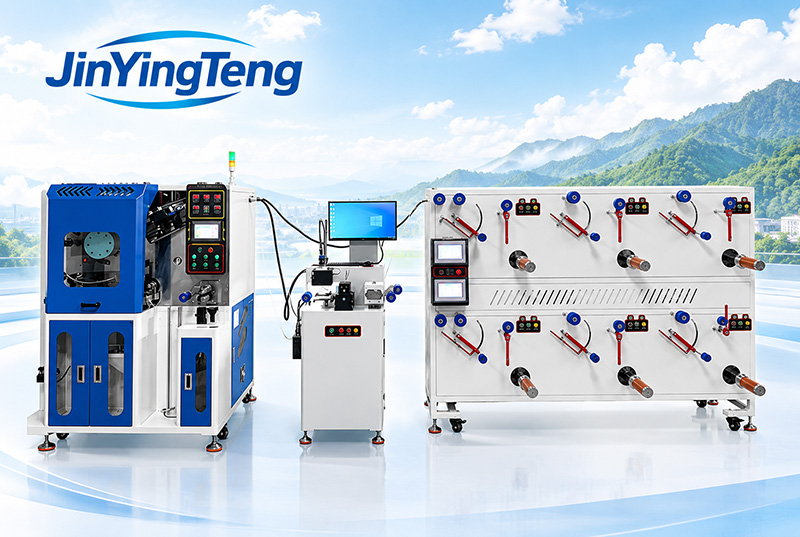
Zhengzhou Jinyingteng (Henan Jenten) manufactures carrier tape forming equipment designed for precision manufacturing. Our roller-type forming systems integrate thermal forming, independent servo punching, inspection, and multi-lane reeling into a single production line. Whether the application involves standard 8mm tape at high volume or advanced packages requiring tighter dimensional control, our forming equipment provides the foundation for consistent output.
 VI
 EN_GB
 ID
 KO
 RU