LED Packaging Trends: Demand for Smaller, Precise Carrier Tapes
LED packaging is undergoing a structural transformation. The global LED carrier tape market was valued at approximately 2.366 billion RMB in 2025 and is projected to reach 3.364 billion RMB by 2032, growing at a CAGR of 5.2% . Behind this growth is a fundamental shift in what LED manufacturers need from their packaging: smaller pockets, tighter tolerances, and carrier tape forming equipment capable of holding dimensional precision at production volume.
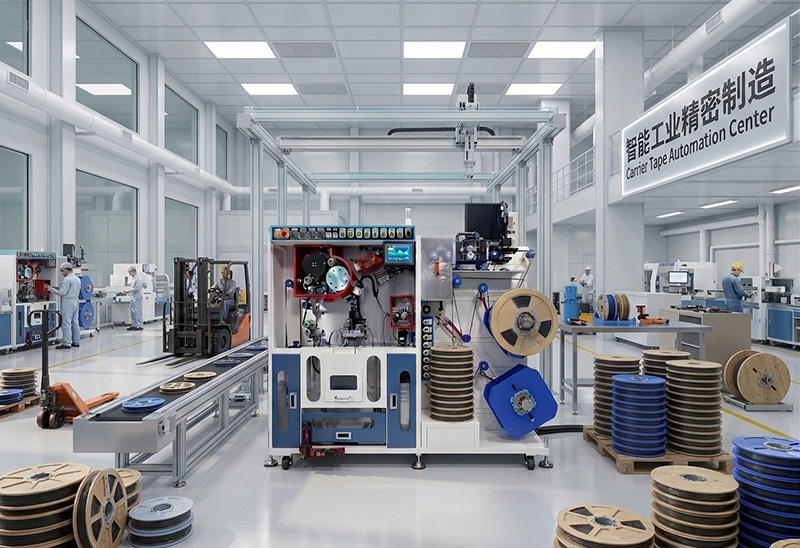
Zhengzhou Jinyingteng (Henan Jenten) manufactures carrier tape forming equipment designed for LED packaging requirements. Our roller-type forming systems integrate material handling, thermal forming, precision punching, inspection, and multi-lane reeling—addressing the dimensional demands that emerging LED package types impose on carrier tape production.
The Shift Toward Smaller LED Packages
LED packaging has moved decisively toward miniaturization. Chip LEDs, once packaged in relatively large form factors, now appear in compact configurations that demand corresponding reductions in carrier tape pocket dimensions. The application segment analysis shows Surface Mount Devices and Chip LEDs driving steady expansion, fueled by integration into automotive lighting, general illumination, and display technologies .
The component-level trend is clear. As LED packages shrink to accommodate higher-density lighting designs and more compact end products, the carrier tape must shrink with them. A pocket that was acceptable for a 3.5mm by 2.8mm package becomes oversized for a 2.0mm by 1.6mm package. The component shifts position during transport, the pick nozzle struggles to maintain alignment, and placement yield declines.
This isn’t a hypothetical concern. Industry analysis of semiconductor packaging trends notes that newer package types, including WLCSP, can require pockets that are 44% shallower than those for larger devices—with tolerances of 30 micrometers that only high-precision polycarbonate carrier tape can consistently deliver .
Why Standard Tolerances Are Insufficient
EIA-481 and IEC 60286-3 define carrier tape specifications. These standards allow pocket dimension deviations up to 100 micrometers for general-purpose packaging . For standard passive components and larger LED packages, that window is workable.
Smaller LED components require tighter control. The standard 100-micrometer tolerance allows excessive rotation or tilt within the pocket. Once the component tilts, the pick nozzle may contact the package at an angle rather than flat-on. Placement offset follows. In high-speed LED assembly, where placement rates can exceed 100,000 components per hour, even small alignment deviations accumulate into yield loss.
The practical target for smaller LED packages is approximately 50 micrometers—half the standard allowance . For the most demanding applications, 30-micrometer tolerance becomes the requirement. Achieving this consistently places direct demands on the carrier tape forming equipment.
The Role of Carrier Tape Forming Equipment
Carrier tape forming equipment determines whether pocket dimensions hold within these windows across production runs. The forming process controls pocket geometry through mold temperature, forming pressure, vacuum assist, and material pre-heating. Independent adjustment of these parameters allows operators to tune the process for specific LED package dimensions.
Jinyingteng’s roller-type carrier tape forming machines address LED packaging requirements through several engineering decisions.
Pre-heating before forming. A pre-heating stage raises the base film temperature before it enters the forming zone. This reduces the thermal gradient across the pocket wall and supports uniform material flow. For PC and PS materials commonly used in LED carrier tape, controlled pre-heating contributes to consistent pocket depth and sidewall integrity.
Water circulation mold temperature control. Mold temperature stability is maintained through active cooling. This counteracts heat input from continuous forming and prevents the thermal expansion-related dimensional drift that occurs in extended production runs.
Independent servo punching. The punching module operates with independent servo control, separate from the tape drive system. Sprocket hole positioning is not affected by variations in tape tension or speed. The in-mold precision positioning structure maintains P2 within ±0.03mm for small-component carrier tape.
Material Considerations for LED Packaging
LED carrier tape spans a range of material options, each with trade-offs relevant to precision requirements.
Polycarbonate (PC) offers the dimensional stability needed for small LED packages. Its low shrinkage—typically less than 0.1% after 24 hours at 85°C—supports pocket dimension retention across extended storage periods. PC is the material of choice when tolerance requirements tighten below 50 micrometers .
Polystyrene (PS) provides a cost-effective alternative for less demanding applications. However, PS exhibits higher camber tendencies than PC, which can affect tape tracking through the feeder if forming and cooling are not carefully controlled .
Jinyingteng’s forming equipment accommodates PC, PS, ABS, and other plastic materials, with base film thickness up to 0.4mm and widths up to 120mm depending on configuration.
Multi-Lane Production for LED Volume
LED packaging operates at scale. The carrier tape forming equipment must match production volume without compromising dimensional consistency. Roller-type forming machines, in contrast to flat-plate systems, support continuous high-speed output with multiple lanes feeding a single forming stage.
Jinyingteng’s roller-type carrier tape forming machines offer one-to-six production configurations—enabling multiple tape lanes from a single forming line. This configuration suits LED component portfolios where multiple package sizes or specifications run concurrently.
The punching module features a quick-release tooling design allowing die changes in approximately one minute. For manufacturers running multiple LED component families, reduced changeover time translates directly into higher equipment utilization.
Quality Verification Within the Forming Process
Carrier tape defects that reach the LED placement machine are costly. A pocket with dimensional deviation causes component tilt or placement offset. Particulate contamination from punching or slitting interferes with cover tape adhesion.
Jinyingteng integrates CCD inspection into the carrier tape production line, using a 5-megapixel camera with algorithms configured to check dimensional parameters and surface defects. Real-time curve plotting enables operators to identify dimensional drift before it produces out-of-spec tape, while CPK statistics provide ongoing process capability data. The cleaning section combines high-speed brush action with ionized air to remove debris generated during punching and slitting.
Engineering Partnership for LED Carrier Tape Production
The LED packaging trajectory is unambiguous: smaller packages, tighter tolerances, higher production volumes. Carrier tape forming equipment must evolve in parallel.
Zhengzhou Jinyingteng (Henan Jenten) works with LED manufacturers to configure carrier tape forming equipment around their specific package portfolios and production volumes. Whether the requirement involves standard 8mm tape at high volume or mixed-width production across multiple LED component families, our roller-type forming systems are designed to deliver dimensional consistency at production speed.
 EN_GB
 ID
 KO
 VI
 RU