소비자 가전 제품 제조: 캐리어 테이프에 대한 수요 증가
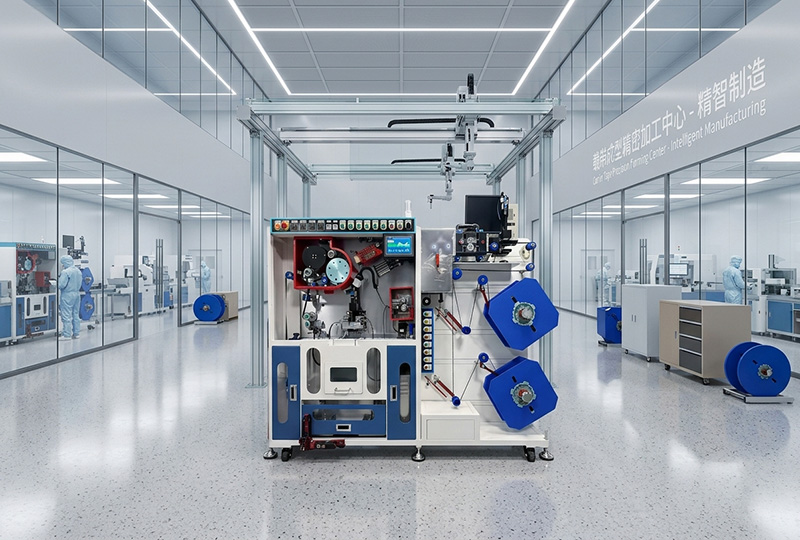
Consumer electronics production is accelerating, and the packaging that delivers components to the assembly line is under pressure to keep pace. Global consumer electronics revenue was valued at USD 855.66 billion in 2025 and is projected to reach USD 1,470.36 billion by 2034, growing at a CAGR of 6.2%. This expansion translates directly into demand for 캐리어 테이프 성형 장비—the machinery that produces the tape-and-reel packaging enabling high-speed surface mount assembly.
정저우 진잉텡(허난 젠텐)은 다음 제품을 제조합니다. 캐리어 테이프 성형 장비 designed for the precision and throughput requirements of consumer electronics manufacturing. Our roller-type and flat-plate forming systems integrate material handling, thermal forming, precision punching, inspection, and multi-lane reeling into a single production line. The engineering objective is straightforward: produce carrier tape that feeds without interruption at the pick-and-place machine.
The Packaging Interface in Consumer Electronics Assembly
Consumer electronics devices—smartphones, wearables, laptops, smart home devices—share a common manufacturing characteristic: they are assembled from surface mount components that must be packaged for automated handling. Carrier tape serves as the transport medium, holding each component in a precision-formed pocket until the placement nozzle retrieves it.
The dimensions of that pocket are not arbitrary. Standards such as EIA-481 define critical parameters including pocket dimensions, sprocket hole pitch, and camber tolerance. For the smallest components used in consumer electronics, these tolerances are measured in fractions of a millimeter. A 0402 resistor, for example, requires a pocket width of approximately 0.65mm and length of approximately 1.15mm. The carrier tape forming equipment must hold this geometry across thousands of pockets and hundreds of meters of tape.
Why Consumer Electronics Drives Carrier Tape Demand
Miniaturization
Component sizes in consumer electronics continue to shrink. The industry has moved from 0603 to 0402 and even 01005 form factors in high-density designs. Smaller components require smaller pockets, which in turn demand higher precision from the forming process. A pocket that is undersized causes component tilt or placement failure. A pocket that is oversized allows the component to shift during transport, producing the same outcome.
The market research reflects this trend. Component miniaturization is identified as a driver expanding the market for precision carrier tape solutions. Forming equipment that can maintain pocket dimensional consistency at small scales becomes a production requirement rather than a preference.
Production Volume
Consumer electronics manufacturing operates at scale. Global demand for devices continues to rise, particularly in Asia Pacific, which accounted for 43.5% of the consumer electronics market in 2025. This volume creates a corresponding requirement for carrier tape production capacity.
High-speed carrier tape forming equipment addresses this through continuous production methods. Roller-type forming machines, in particular, support high-speed output with multiple lanes feeding a single forming stage—a configuration suited to volume manufacturing.
Material Versatility
Consumer electronics components span a range of sensitivity levels and cost profiles. Carrier tape materials must match these variations. Polystyrene (PS) offers a cost-effective solution for general-purpose components. Polycarbonate (PC) provides lower shrinkage and better dimensional stability for more demanding applications. Conductive materials address ESD protection requirements.
The forming equipment must accommodate this range. Jinyingteng’s carrier tape forming machines are compatible with PC, PS, ABS, and other plastic materials, with base film thickness up to 0.4mm and widths up to 120mm depending on the configuration.
캐리어 테이프 성형 장비에 대한 기술적 요구 사항
Pocket Dimension Precision
Pocket geometry determines whether a component remains properly seated during transport and whether the pick nozzle can retrieve it reliably. Standards define allowable tolerances, but consumer electronics production often targets tighter windows than the baseline.
The forming process controls pocket dimensions through several variables: mold temperature, forming pressure, vacuum assist, and material pre-heating. Independent adjustment of these parameters allows operators to tune the process for specific pocket geometries and materials.
Sprocket Hole Accuracy
The sprocket holes engage the feeder mechanism that advances the tape to the pick position. Pitch accuracy, expressed as P2 tolerance, directly affects indexing precision. Cumulative error in sprocket hole positioning produces misalignment that accumulates over the tape length.
Jinyingteng’s forming equipment addresses this through independent servo control at the punching stage. The in-mold precision positioning structure maintains P2 within ±0.03mm for small-component carrier tape, with punch and die fabricated using slow-wire EDM for consistent clearances.
Production Continuity
Carrier tape that meets dimensional specifications must also feed without interruption. Camber beyond the standard limit of 1mm lateral movement across 250mm of tape causes tracking errors. Surface irregularities that extend into the cover tape bonding zone compromise adhesion consistency.
The forming equipment influences these outcomes through mold cooling uniformity, pre-heating consistency, and tape tension control during reeling. Jinyingteng’s systems incorporate water circulation temperature control, enclosed material feed sections for humidity protection, and independent tension regulation at the reeling stage.
High-Precision Forming for Advanced Consumer Electronics
As consumer electronics integrate more functionality into smaller packages, the carrier tape forming equipment must evolve in parallel. In-line inspection capability has become a differentiator for mid- to high-end tape production, with real-time dimensional monitoring enabling detection of process drift before defects reach the reeling stage.
Jinyingteng integrates CCD inspection into its carrier tape production lines. The system checks dimensional parameters and surface defects, plots real-time dimensional curves, and provides CPK statistics for process capability verification. This closes the quality loop within the forming equipment rather than relying on downstream inspection.
Engineering Partnership for Consumer Electronics Packaging
Carrier tape production for consumer electronics is ultimately measured by one metric: whether the tape feeds without interruption at the placement machine. Every engineering decision—from mold temperature control to independent punching servo to single-origin reeling calibration—serves that objective.
Zhengzhou Jinyingteng (Henan Jenten) works with consumer electronics manufacturers to configure 캐리어 테이프 성형 장비 around their specific component portfolios and production volumes. Whether the requirement involves standard 8mm tape at high volume or mixed-width production across multiple component families, our forming systems are designed to deliver dimensional consistency at production speed.
 KO
 EN_GB
 ID
 VI
 RU