High-Speed Carrier Tape Production for a Leading SMT Factory: Engineering Uptime at the Feeder
Pick-and-place machines are designed to run continuously. Feeder interruptions, reel changeovers, and tape-related stoppages are among the most persistent threats to SMT line utilization. For high-volume manufacturers, a carrier tape production system that delivers consistent tape quality at speed is not simply a packaging consideration—it is a production reliability asset.
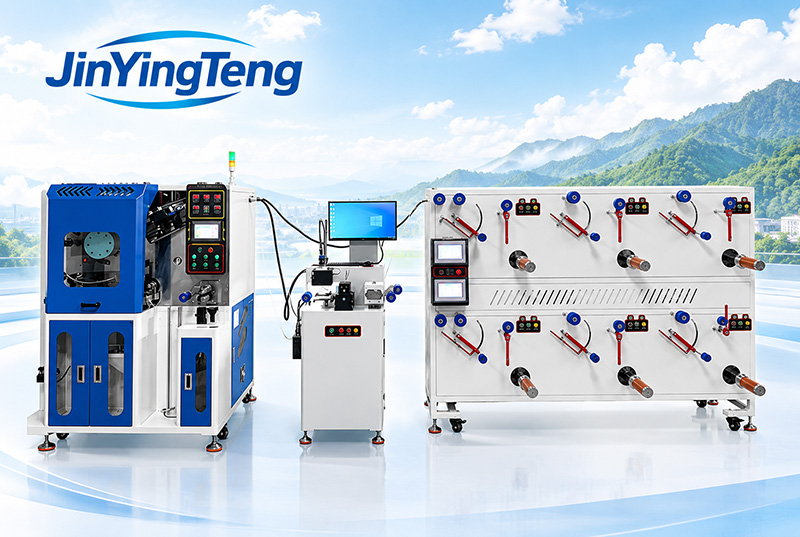
Jinyingteng supplies carrier tape forming equipment to SMT factories where downtime at the feeder translates directly into lost output. Our roller-type forming machines integrate precision forming, punching, slitting, inspection, and multi-lane reeling into a single production workflow, enabling high-speed tape manufacturing with the dimensional consistency that high-throughput placement demands.
The Feeder Interface: Why Carrier Tape Quality Determines Uptime
An SMT feeder advances carrier tape by engaging the sprocket holes and indexing each pocket to the pick position. Every tape-related stop—whether caused by cumulative pitch error, pocket dimension drift, or tape camber—interrupts that indexing cycle. A carrier tape that meets EIA-481 cumulative pitch tolerance of ±0.2mm over 10 sprocket holes provides the basic dimensional foundation. However, high-speed production environments often demand tighter control than the standard requires.
The practical reality is that feeder interruptions are rarely caused by a single out-of-spec dimension. They result from the interaction of pitch accuracy, pocket geometry, tape stiffness, and splice quality. When reel changeovers occur frequently—as they do on high-volume lines—even small inconsistencies in tape flatness or sprocket hole positioning can accumulate into feeder alarms or placement errors.
This is why the forming equipment matters. Carrier tape produced on a machine with independent servo control at both the punching and reeling stages exhibits less dimensional variation from reel to reel. That consistency directly reduces the frequency of feeder interventions.
High-Speed Production Without Dimensional Drift
Speed in carrier tape production cannot come at the expense of dimensional stability. The thermal forming process must maintain pocket geometry even as line speed increases. Jinyingteng’s roller-type carrier tape forming machine addresses this through several engineering choices.
The forming module uses imported 7075 aluminum alloy molds with water circulation temperature control. Mold temperature stability is maintained through active cooling, which counteracts the heat input from the forming process and prevents thermal expansion-related dimensional drift. Independent adjustment of vacuum force and hot air angle allows operators to maintain forming conditions as production speed changes.
A pre-heating stage raises the base film temperature before it enters the forming zone. This reduces the thermal gradient across the pocket wall and supports uniform material flow during forming. For PC and PS materials commonly used in SMT applications, controlled pre-heating contributes to consistent pocket depth and sidewall integrity.
The punching module operates with independent servo control, separate from the tape drive system. This decoupling means that sprocket hole positioning is not affected by variations in tape tension or speed. The in-mold precision positioning structure, fabricated with slow-wire EDM, maintains P2 tolerance within ±0.03mm for small-component carrier tape—a level of accuracy that supports reliable feeder indexing at high placement rates.
The Economics of Reduced Changeover Time
SMT factories running high-mix production schedules face a compounding cost: each reel changeover consumes operator time and introduces variability. While splicing equipment addresses the physical tape connection, the upstream carrier tape production process determines how consistently tape can be delivered to the line.
Jinyingteng’s reeling configuration supports up to six lanes from a single forming line, with independent tension control and servo-driven winding stations. A notable feature is the single-origin calibration approach. When switching between reel widths, operators enter the new width through the interface rather than performing mechanical recalibration. The system allows separate programming of reel gap, tape overlap distance, and the angle at which tape reverses direction at the reel edge.
For factories running multiple component families across different reel formats, this setup flexibility reduces the time required to reconfigure the reeling section between production runs.
Material Versatility for SMT Applications
SMT packaging spans a range of component types and sensitivity requirements. Polycarbonate carrier tape offers low shrinkage characteristics, maintaining pocket dimensional stability over extended storage periods—a consideration when inventory cycles extend beyond immediate production needs. Polystyrene tape provides a cost-effective alternative for less sensitive components.
Jinyingteng’s forming equipment accommodates base film up to 56mm wide and 0.4mm thick, with material compatibility including PC, PS, and ABS. The reeling section accepts reel diameters up to 700mm, supporting extended run times between reel changes.
Inspection: Closing the Quality Loop
Carrier tape defects that reach the feeder are costly. A pocket with dimensional deviation can cause component tilt or placement offset. Particulate contamination from punching or slitting can interfere with cover tape adhesion.
Jinyingteng integrates CCD inspection into the carrier tape production line, using a 5-megapixel camera with algorithms configured to check dimensional parameters and surface defects. Real-time curve plotting enables operators to identify dimensional drift before it produces out-of-spec tape, while CPK statistics provide ongoing process capability data. The cleaning section combines high-speed brush action with ionized air to remove debris generated during punching and slitting.
Engineering for SMT Production Realities
Carrier tape production for SMT factories is ultimately measured by one metric: whether the tape feeds without interruption. Every engineering decision—from mold temperature control to independent punching servo to single-origin reeling calibration—serves that objective.
Jinyingteng works with SMT manufacturers to configure carrier tape forming systems around their specific component portfolios and production volumes. Whether the requirement involves standard 8mm tape at high volume or mixed-width production across multiple component families, our roller-type forming equipment is designed to deliver dimensional consistency at production speed.
 EN_GB
 ID
 KO
 VI
 RU